STRATEGIC OVERVIEW
The Essequibo dispute has transformed from a dormant territorial disagreement into a high-stakes geopolitical confrontation driven by energy resources. Covering roughly two-thirds of Guyana's territory, the region has gained renewed strategic importance following major offshore oil discoveries since 2015.
By 2026, Guyana has emerged as one of the fastest-growing oil producers globally, fundamentally altering the regional balance. Venezuela, facing prolonged economic crisis and declining oil production capacity, increasingly views Essequibo not only as a historical claim but as a strategic economic necessity.
This shift has elevated the dispute from legal arbitration to a multi-domain pressure strategy where military signaling, diplomatic engagement, and economic interests intersect.
THREAT VECTOR ANALYSIS
Territorial Assertion and Political Signaling
Venezuela's renewed claims — reinforced by domestic political messaging — serve both internal legitimacy and external pressure purposes. The use of referendums and official mapping initiatives indicates a move toward normalizing the claim domestically and projecting it internationally.
Energy Competition
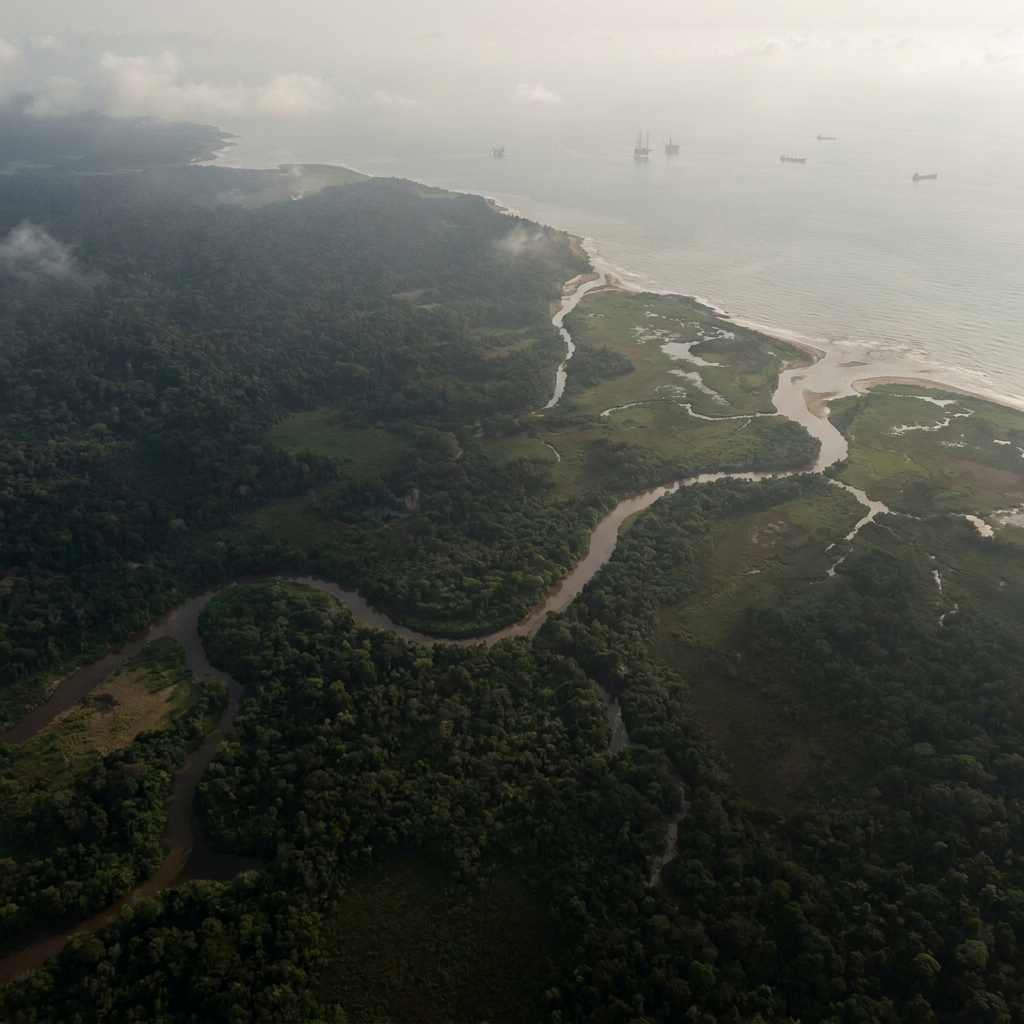
The presence of major international energy companies in Guyana's offshore fields has globalized the dispute. Oil infrastructure, while not directly targeted, represents a high-value strategic vulnerability in any escalation scenario, with implications for global energy markets.
Military Posturing
While no large-scale mobilization has occurred, Venezuela has increased troop visibility near border regions and conducted military exercises. These actions are calibrated to signal capability without triggering direct confrontation.
Legal and Diplomatic Dimension
Guyana's reliance on the International Court of Justice reflects a strategy of legal containment. However, legal processes are slow, creating a gap that Venezuela may exploit through sustained pressure tactics.
MILITARY POSTURE
Venezuela maintains a clear advantage in conventional military capabilities, including a larger standing army, air force assets, and armored units. However, its effectiveness is constrained by:
- Logistical limitations — limited operational reach into dense rainforest terrain.
- Economic degradation — sustained sanctions and currency collapse have eroded readiness.
- Maintenance challenges — depleted spare-parts pipelines for legacy Russian and Western platforms.
Guyana, in contrast, has a small military force but is rapidly increasing defense cooperation with external partners, particularly the United States and Brazil. This creates a deterrence-through-alignment model, where external backing offsets internal weakness. Notably, neither side appears prepared for full-scale war — the posture reflects controlled escalation and signaling rather than imminent conflict.
OUTLOOK
The most likely trajectory is continued tension without major conflict. Key developments to monitor include:
- Increased Venezuelan political rhetoric tied to domestic instability.
- Expansion of Guyana's oil production capacity.
- Greater involvement of external actors, particularly the United States and Brazil.
- Potential maritime incidents near offshore energy zones.
While war remains unlikely, localized incidents or miscalculations could trigger short-term escalation.
"The Essequibo dispute is best understood as an energy-driven geopolitical contest masked as a territorial claim. Venezuela's actions are less about immediate territorial acquisition and more about leveraging pressure for strategic and economic concessions." — Based on Reuters, BBC, ICJ documentation, and EIA reports.
OUTLOOK SUMMARY
The Essequibo question will not be resolved by a single court ruling or referendum. It will be shaped by the relative trajectory of two oil economies — one rising rapidly, one in long-term decline — and by how much external deterrence the United States and Brazil are willing to underwrite. The dispute is therefore a useful proxy for watching how energy geopolitics are reorganizing the Western Hemisphere.
FREQUENTLY ASKED QUESTIONS
What is the Essequibo dispute between Venezuela and Guyana?
The dispute centers on a large, resource-rich territory administered by Guyana but claimed by Venezuela. It has both historical and legal dimensions.
Why is the conflict escalating in 2026?
Renewed political attention and energy discoveries have intensified strategic interest in the region. This has led to increased rhetoric and tension.
How important are oil reserves in the dispute?
Oil discoveries have significantly increased the economic value of the contested area. This has made the dispute more strategically relevant.
Could the conflict lead to military confrontation?
While immediate conflict is unlikely, the risk of escalation remains if tensions continue or incidents occur. Military posturing could increase under pressure.
Which areas are claimed by Venezuela?
Venezuela claims a substantial portion of territory currently governed by Guyana, including offshore zones linked to energy exploration.
How are international actors responding?
International actors are emphasizing diplomatic resolution and legal processes. Monitoring and mediation efforts aim to prevent escalation.
AUTHOR
Arda Alkis is an energy and hybrid conflict analyst specializing in maritime security, strategic chokepoints, and irregular warfare. His work is based on open-source intelligence and data from ACLED (Armed Conflict Location & Event Data), the International Crisis Group (ICG), and international reporting networks. He focuses on energy-driven conflicts, proxy warfare, and instability across the Middle East, Africa, and global trade corridors.
Read more about the WarWatch editorial team on the About page.
SOURCES AND REFERENCES
- International Energy Agency (IEA)
- U.S. Energy Information Administration (EIA)
- Reuters – Energy
- Lloyd's List (Maritime)
- United Nations OCHA
TRACK LATIN AMERICA SECURITY DEVELOPMENTS IN REAL TIME
⊙ OPEN LIVE MAP