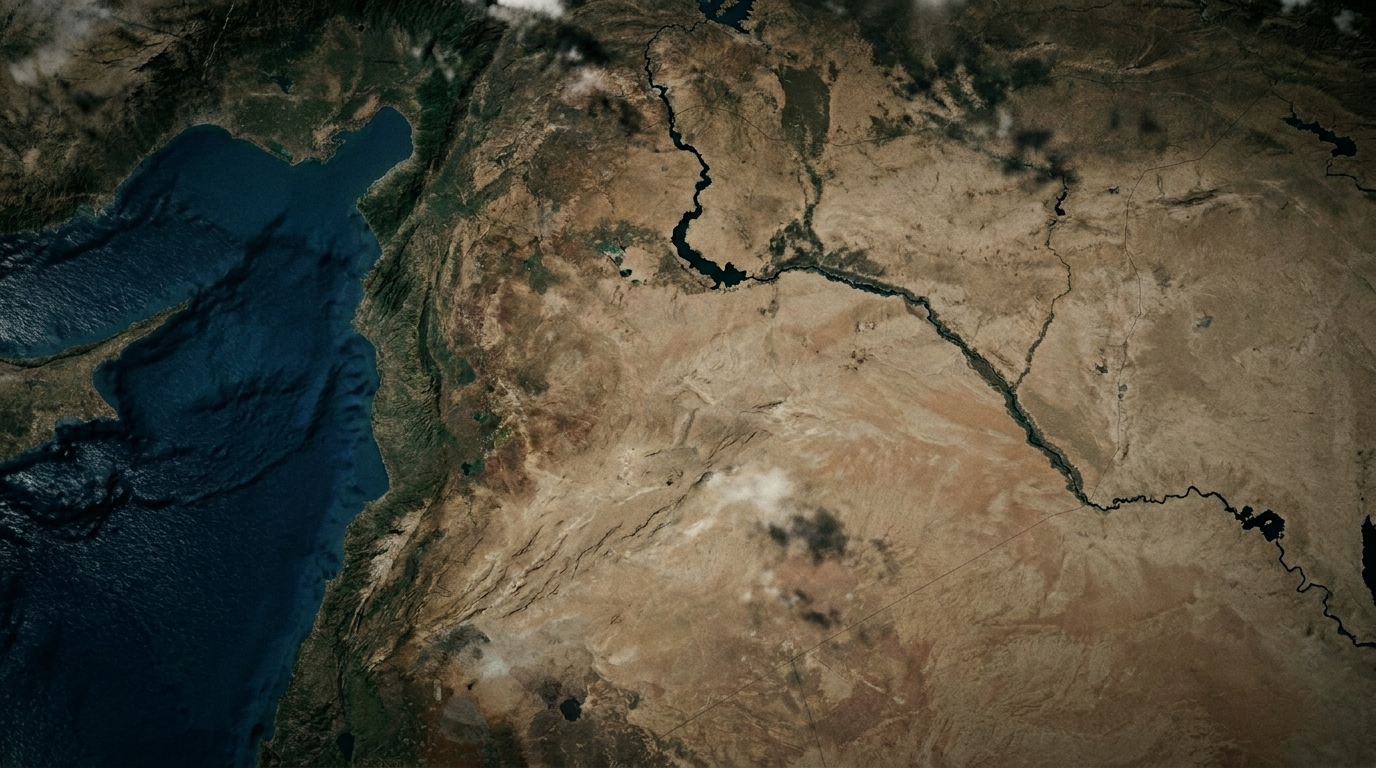
STRATEGIC OVERVIEW
The post-Assad phase in Syria has not resulted in a unified political order but instead created a complex transitional landscape defined by fragmented authority, competing governance structures and sustained external influence. Following the collapse of centralized control, multiple actors have moved to fill the vacuum, producing a patchwork of territorial zones with varying levels of stability and governance capacity.
By 2026, Syria is no longer characterized by a single front line but by overlapping spheres of influence, where transitional bodies, local militias and foreign-backed forces operate simultaneously. While large-scale conventional warfare has declined, the conflict has shifted into a persistent low-intensity environment marked by instability, localized clashes and structural uncertainty.
The absence of a cohesive national framework continues to delay reconstruction, limit humanitarian access and prolong systemic fragility across the wider Levant region.
THREAT VECTOR ANALYSIS
Governance Fragmentation
The lack of centralized authority remains the most critical structural challenge:
- Multiple administrations claim legitimacy across different regions.
- Governance capacity varies widely between territories.
- National institutions remain incomplete or non-functional.
This fragmentation increases the risk of long-term division and parallel governance systems that may harden over time.
Militia Proliferation
Non-state armed groups continue to dominate large parts of the security environment:
- Former opposition factions retain localized control over urban districts and rural belts.
- Militias manage checkpoints, logistics and security operations.
- Integration into a unified national force remains limited and contested.
The result is a hybrid security structure where formal and informal power centers coexist — and frequently compete.
External Influence
Syria remains a strategic arena for external actors:
- Regional and global powers maintain influence through aligned groups and proxies.
- Military presence and advisory roles continue in key areas, particularly in the north and east.
- Competing geopolitical interests slow political normalization and recognition.
External involvement reinforces fragmentation and complicates the restoration of meaningful sovereignty.
Economic Collapse & Reconstruction Barriers
Economic conditions remain a major source of instability:
- Widespread infrastructure damage in urban and industrial zones, including power, water and transport networks.
- Limited international investment due to political uncertainty and sanctions exposure.
- Persistent inflation, unemployment and a weakened currency.
Without coordinated reconstruction, economic stagnation will continue to reinforce instability and social unrest.
Population Displacement
Displacement continues to shape the post-conflict environment:
- Millions remain internally displaced or outside the country in Türkiye, Lebanon, Jordan and Europe.
- Return rates are slow due to security conditions, property disputes and economic uncertainty.
- Demographic shifts are influencing local power dynamics in mixed regions.
These factors directly impact long-term stability and the legitimacy of any transitional governance.
MILITARY POSTURE
The military landscape has transitioned from conventional warfare to distributed and localized control:
- Transitional forces maintain partial control over key urban centers.
- Militias dominate rural and contested areas, often with shifting loyalties.
- External actors retain strategic positions in selected regions, including bases and forward outposts.
Large-scale offensives are limited, but localized clashes, targeted operations and security incidents remain frequent. The overall posture reflects a sustained low-intensity conflict environment rather than full stabilization.
OUTLOOK
Syria's transition phase is expected to remain prolonged and unstable. Key developments to monitor include:
- Efforts to consolidate governance structures and rebuild central institutions.
- Integration or disarmament of militia forces.
- Shifts in external actor involvement, particularly Turkey, Iran, Russia, the United States and Israel.
- Progress or stagnation in reconstruction and sanctions relief.
A rapid stabilization scenario is unlikely. Instead, Syria may evolve into a semi-fragmented state with uneven governance and recurring instability across multiple zones.
"The end of centralized rule has not resolved the Syrian conflict — it has transformed it into a decentralized system of competing authorities, where stability depends on fragile balances rather than strong institutions." — Based on UN reporting, ICG, Reuters and BBC regional assessments.
OUTLOOK SUMMARY
Syria in 2026 is no longer a war for the state — it is a contest over what the state will become. The transitional period is being shaped less by formal politics than by the on-the-ground arithmetic of who controls which checkpoint, which crossing and which oil field. Until that arithmetic stabilizes, reconstruction, refugee return and full international reintegration will remain out of reach.
FREQUENTLY ASKED QUESTIONS
What could happen after Assad in Syria?
A post-Assad scenario could lead to a fragmented political landscape with multiple competing factions.
Which groups could fill the power vacuum?
Various local and regional actors, including armed groups and political entities, could compete for control.
Why is Syria at risk of fragmentation?
Years of conflict, external involvement, and weakened central authority contribute to fragmentation risk.
How would reconstruction be managed?
Reconstruction would require international coordination, funding, and political agreements.
Which regions are controlled by different factions?
Different regions remain under the influence of various actors, including government forces and local groups.
What role do foreign forces play in Syria?
Foreign actors continue to influence the conflict through military presence and political engagement.
AUTHOR
Arda Alkis is an energy and hybrid conflict analyst specializing in maritime security, strategic chokepoints, and irregular warfare. His work is based on open-source intelligence and data from ACLED (Armed Conflict Location & Event Data), the International Crisis Group (ICG), and international reporting networks. He focuses on energy-driven conflicts, proxy warfare, and instability across the Middle East, Africa, and global trade corridors.
Read more about the WarWatch editorial team on the About page.
SOURCES AND REFERENCES
- ACLED (Conflict Data)
- United Nations OCHA
- International Crisis Group (ICG)
- Reuters – Africa
- BBC News Africa
TRACK SYRIA AND LEVANT DEVELOPMENTS IN REAL TIME
⊙ OPEN LIVE MAP