STRATEGIC OVERVIEW
Libya in 2026 remains a fragmented state with competing centers of power, where political agreements have failed to translate into unified governance. Despite multiple ceasefire attempts and UN-backed political processes, the country continues to operate under a dual-authority structure, with rival administrations in the west and east.
The capital, Tripoli, is controlled by the Government of National Unity (GNU), while eastern Libya remains under the influence of the Libyan National Army (LNA). However, real power is often held not by formal institutions but by local militias controlling territory, infrastructure, and economic flows.
This fragmentation is further complicated by external actors, turning Libya into a proxy environment where regional and international interests intersect. The result is not an active full-scale war, but a volatile equilibrium sustained by competing interests and fragile deterrence.
THREAT VECTOR ANALYSIS
Militia Dominance
Local militias remain the most decisive actors on the ground. These groups control key urban areas, influence political decision-making, and compete for access to state resources. Their shifting alliances create a constantly changing security landscape that undermines any stable institutional structure.
Oil Infrastructure Leverage
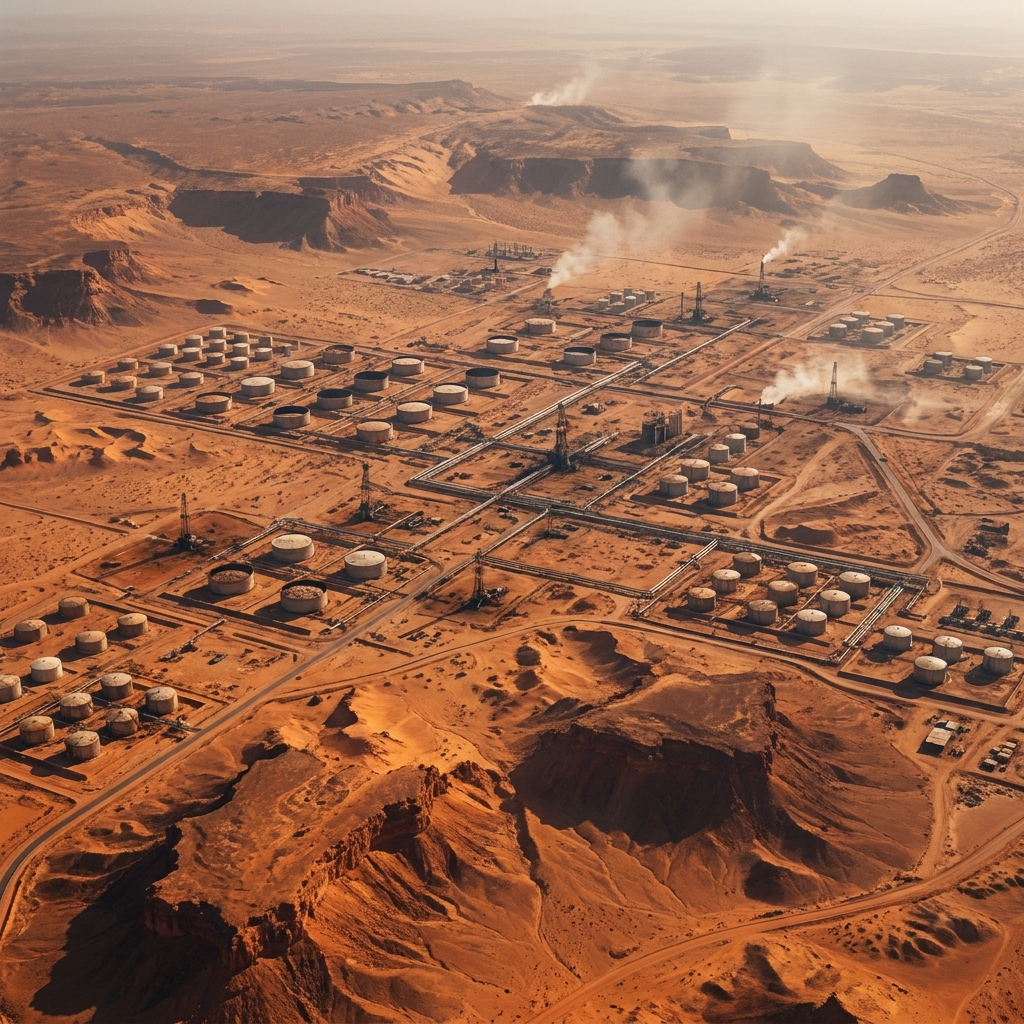
Libya's economy depends heavily on oil exports. Armed groups frequently use oil facilities as leverage by blocking production, threatening infrastructure, and negotiating political concessions. This turns energy infrastructure into a strategic pressure tool rather than a purely economic asset.
External Proxy Dynamics
Foreign involvement continues to shape Libya's conflict. External actors provide military support, training and equipment, and political backing to rival factions. This reduces the likelihood of internal resolution and sustains the conflict as a proxy competition zone.
Political Fragmentation
Repeated failures to hold national elections have deepened institutional divisions. Competing governments lack nationwide legitimacy, reinforcing instability and making any future settlement increasingly difficult to negotiate.
MILITARY POSTURE
Libya's military landscape is highly fragmented:
- GNU-aligned forces rely on coalition militias with varying loyalty.
- LNA maintains a more centralized command but depends heavily on external support.
- Independent militias operate autonomously in key regions, including Misrata, Zintan, and parts of the south.
There is no unified national military capable of enforcing stability across the country. Despite occasional clashes, both major factions avoid full-scale confrontation due to risk of external escalation, the economic consequences of disrupted oil production, and the broader balance of power. The overall posture reflects a deterrence-through-fragmentation model, where no single actor can dominate.
OUTLOOK
Libya is likely to remain in a state of prolonged instability without decisive conflict resolution. Key trends include:
- Continued militia influence over governance and economic flows.
- Periodic localized clashes in urban centers.
- Ongoing disruptions to oil production tied to political bargaining.
- Persistent foreign involvement and proxy alignments.
A comprehensive political settlement remains unlikely without significant external coordination and internal compromise.
"Libya's situation is best described as a 'managed instability' environment, where conflict persists at a level below full war but above sustainable peace. The absence of a strong central authority ensures that fragmentation will continue to define the country's trajectory." — Based on UNSMIL, Reuters, BBC, and International Crisis Group reporting.
OUTLOOK SUMMARY
The most useful question about Libya in 2026 is not "when will the war end?" but "how long can a country function without a unified state?" The answer so far is: surprisingly long, but at a steadily mounting cost. Each year of fragmentation makes reunification harder, as parallel institutions, militia economies, and external patron relationships harden into the new normal.
FREQUENTLY ASKED QUESTIONS
What is the current state of conflict in Libya in 2026?
Libya remains divided between competing political and military factions, with fragile ceasefires and ongoing tensions.
Who are the main factions controlling Libya?
Multiple factions, including rival administrations and armed groups, control different parts of the country.
Why has Libya remained divided since 2011?
The absence of unified governance, external involvement, and internal rivalries have sustained fragmentation.
How do foreign powers influence the conflict?
External actors provide political, financial, and military support to different factions, shaping the conflict dynamics.
Which regions are most strategically important?
Key regions include areas with energy infrastructure, major cities, and transportation corridors.
What are the risks of renewed large-scale fighting?
Breakdown of ceasefire arrangements or political processes could trigger renewed large-scale conflict.
AUTHOR
Arda Alkis is an energy and hybrid conflict analyst specializing in maritime security, strategic chokepoints, and irregular warfare. His work is based on open-source intelligence and data from ACLED (Armed Conflict Location & Event Data), the International Crisis Group (ICG), and international reporting networks. He focuses on energy-driven conflicts, proxy warfare, and instability across the Middle East, Africa, and global trade corridors.
Read more about the WarWatch editorial team on the About page.
SOURCES AND REFERENCES
- ACLED (Conflict Data)
- United Nations OCHA
- International Crisis Group (ICG)
- Reuters – Africa
- BBC News Africa
TRACK NORTH AFRICA SECURITY DEVELOPMENTS IN REAL TIME
⊙ OPEN LIVE MAP